

The clients says.
"Thoroughly checked that everything worked as it should."
May C.
Gentofte
"Arrived ahead of time. Improved what needed to be improved."
Kim N.
Stoneless
"Super work and clear communication all the way..."
Michael B.
Naerum

"Really good and friendly service"
John B.
Charlottenlund
"Zhiar was nice and helpful... He fixed my exhaust in 30 minutes."
Simone ES
Copenhagen
"Good quality, very helpful and good at guiding..."
Tobias I.
Koege
Radon and moisture measurements
Radon is an invisible, odourless gas that forms naturally in the ground and can seep up through foundations, cracks and pipe penetrations. When radon builds up in indoor air, it increases the risk of lung cancer over time. You can neither see nor smell it, so the only way to find out how things stand in your home is to measure.
When should you have radon measured?
-
If you own a home, especially older houses and houses with a basement or plinth
-
Before you buy or sell a home
-
After a major renovation or after installing a wood stove
-
If you want to document the indoor climate in a commercial property
How the measurement works
Radon is best measured during the heating season, when the house is heated and sealed, and the radon level is most representative. The measurement typically takes place over an extended period, so it gives a picture of the average level and not just a snapshot. We place the detectors in the rooms where people spend the most time, and we help you read and understand the result.
What does the result mean?
The limit in Denmark is 100 Bq/m³. If your home is above that level, there are solutions that are often both simple and effective, such as sealing cracks, adding more ventilation or installing a radon extraction system. We go through the options with you and recommend what suits your home.

We offer one room ventilation systems.
Duka Bsk Zhyr

Sound meassurements
A ventilation system should operate discreetly. If you can hear it while sitting on the sofa or lying in bed, it is a sign that something is not as it should be. A sound measurement provides an objective assessment of the noise level, rather than relying on a subjective impression.
Why measure sound from ventilation systems?
-
Noise disturbances in daily life: Constant rushing, humming, or whistling sounds can be annoying and interfere with sleep and concentration.
-
Building regulation requirements: There are limits on noise from technical installations in homes. A measurement provides documentation that the system complies with these limits—for instance, in new construction projects or following a renovation.
-
Troubleshooting: Measurements can reveal whether the noise originates from the unit itself, the ductwork, the vents, or incorrect system balancing, allowing for a targeted solution.
-
Documentation: Useful during the handover of a new system, in the event of disputes, or in commercial properties where the working environment must be documented.
How the sound measurement is conducted
Using professional equipment, we measure the sound level in the rooms where it matters most—typically bedrooms and living areas—while the system is running under normal operating conditions. The results are compared against applicable requirements and what is considered reasonable for that specific type of system.
What might be causing the noise, and what can be done?
-
Excessive air velocity in ducts or vents: can often be resolved through system balancing
-
Vibrations from the unit: can be addressed with improved suspension or decoupling
-
Noise traveling throughout the house via the ducts: can be dampened using silencers
-
Worn or dirty components: can be remedied through servicing and cleaning
We will review the results with you and suggest solutions that offer the best value for your money.
air measurement
You can rarely see or smell poor air, but you can often feel it: headaches, fatigue, difficulty concentrating, or a sense of heavy air, especially at night and in rooms with many people. An air measurement gives you figures on what the air in your home or business is really like, so you can act on facts rather than feelings.
What can we measure?
-
CO₂ (carbon dioxide): A good indicator of whether the air is being replaced often enough. If the CO₂ level rises, ventilation is often too low for the number of people in the room.
-
Particles and dust: Come from sources such as cooking, candles, wood stoves and outdoor air, and can put a strain on the airways.
-
VOCs (volatile organic compounds): Gases from sources such as building materials, furniture, paint and cleaning products, which can cause odour nuisance and irritation.
-
Temperature and humidity: Greatly affect comfort and the risk of damp and mould. See also our section on moisture measurement.
Why measure the air?
-
You can find out whether the ventilation is sufficient before you invest in new equipment
-
You can document the indoor climate in, for example, offices, schools, institutions and other commercial premises
-
You get a solid basis for choosing the right solution, such as home ventilation, single-room ventilation or an adjustment of your existing system
-
You can follow up after a change and see whether the solution works
How it works
We set up measuring equipment in the relevant rooms and log the values over a period of time, so we get a picture of how things develop over the day and night, not just a snapshot. We then go through the results with you in plain language and point out what can be improved.
Airflow measurement
In addition to air quality, we can measure how much air the system moves. This is crucial for whether a ventilation system works as intended, and it is an important part of the balancing of the ventilation.
balancing
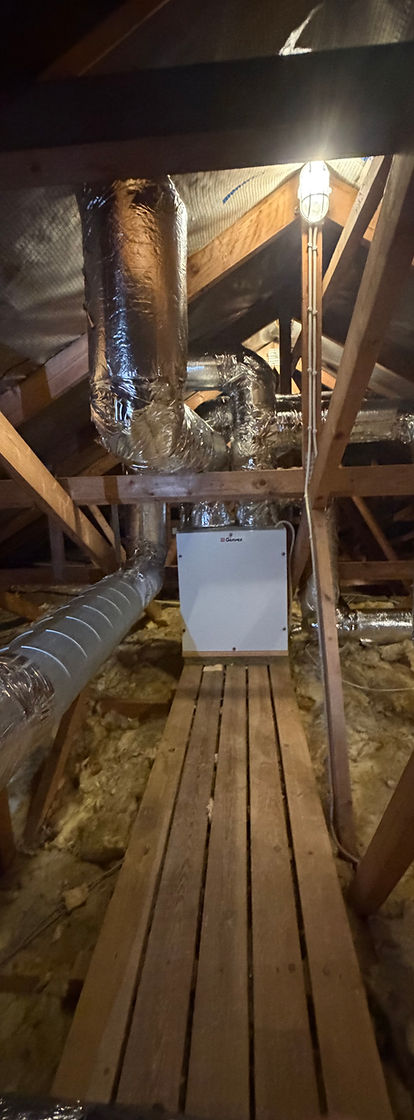
A ventilation system can be expensive and of high quality, and still deliver poor results if it has not been balanced correctly. Balancing means that we measure the airflow in each room and adjust it, so the system delivers exactly what it is designed for and the air is distributed properly throughout the home or building.
Why is balancing important?
-
Better indoor climate: When the air is distributed correctly, every room gets the air it needs, and no rooms are over- or under-ventilated.
-
Less noise and draughts: Excessive air speed in vents and ducts causes whistling and cold draughts. Correct settings reduce both.
-
Lower energy consumption: A system that runs too hard uses unnecessary electricity and heat, while a system that runs too weakly does not change the air often enough.
-
Balance between supply and extract: As much air must be blown in as is extracted. Without balance, positive or negative pressure can occur, which affects both comfort and the efficiency of the system.
-
Longer lifespan: A well-adjusted system suffers less wear.
When should you have your system balanced?
-
After installing a new ventilation system
-
After a renovation or extension where rooms or ductwork have been changed
-
If you experience noise, draughts, cold rooms or stuffy air
-
If the system has never been balanced, or if you are not sure
-
After a filter change or service, where the settings may have been altered
How it works
We measure the airflow at the vents and in the system using calibrated measuring equipment, compare it with the agreed or calculated values, and adjust until the system is in balance. You then receive a short report showing the measured values, so you have documentation that the system is running as it should. We often combine balancing with sound measurement and air measurement, so you get the full picture.
our approach
Contact
Call, write or fill out our form
We review the task and assess what makes sense. If necessary, we come out and inspect the conditions.
You will receive a professional recommendation. We will explain the options and the solution we can offer.
You receive your offer for the task.
Once the solution has been agreed upon, we will carry out the work with a focus on quality, function and correct installation.
We follow up after installation, to make sure, that everything is as you want it to be.
We work in...
North Zealand
Copenhagen area
East Zealand